Group Polls That Actually Get Answers
Stop sending polls that nobody votes on. Here's how to get your group to actually decide things.

The group decision problem
You need to pick a date for the dinner party. You type "When works for everyone?" into the group chat. Three people respond immediately with different dates. Two people say "any day works." One person doesn't respond at all. Someone changes their answer the next day. Another person asks "wait, what are we deciding?"
Two weeks later, you still don't have a date.
Group decisions in chat threads fail for predictable reasons. Messages get buried. Not everyone sees the question. Responses are scattered across dozens of messages. There's no clear way to tally votes. And there's no deadline, so people respond whenever they feel like it—or not at all.
This isn't a communication problem. It's a tools problem. Group chats are designed for conversation, not decisions.
Why most polling tools don't help
You might think the solution is a dedicated polling app. And sometimes it is. But most polling tools have their own set of problems.
The link dies in the chat
You create a poll in some web tool and paste the link into your group chat. Half the group ignores it because they don't recognize the URL. A few people click it but don't want to create an account. By the time someone actually votes, the link has scrolled past 50 messages and the rest of the group can't find it.
It's disconnected from everything else
Even when people do vote, the poll lives in isolation. The result doesn't connect to your event planning. You pick a date in the poll, then you have to manually update the calendar, the venue booking, and the group chat. The poll was a one-off interaction that created more work, not less.
Limited poll formats
Many polling tools only offer basic single-choice polls. But group decisions often need more nuance. "Pick your top 3 restaurants" requires multiple choice. "Rank these date options from best to worst" requires ranked choice. "Are you in or out?" requires a simple yes/no with a headcount. One format doesn't fit all decisions.
What makes a poll actually work
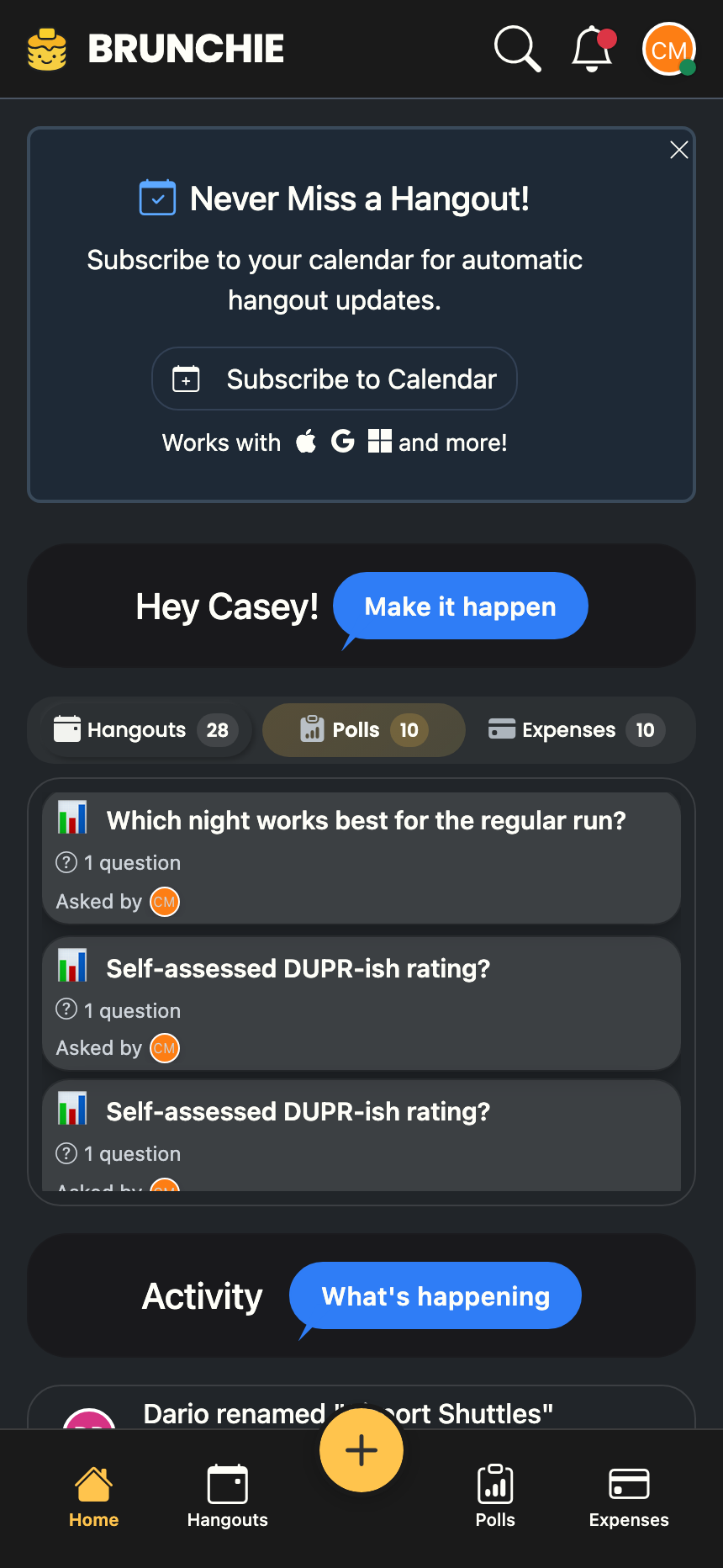
After watching thousands of group decisions play out, a pattern emerges. The polls that get answers share a few key traits.
1. They're attached to context
A poll that lives inside the event it's about—next to the guest list, the itinerary, the expenses—gets more engagement than a random link in a group chat. When people open the event page and see a poll, they understand why it matters. Context drives action.
In Brunchie, polls are part of your hangout. They sit alongside everything else related to your event. When someone checks the itinerary or the guest list, the poll is right there, visible and relevant. No separate link to track down.
2. They have a deadline
Open-ended polls collect responses indefinitely, which means they never actually conclude. A deadline creates urgency. "Vote by Friday" is a clear call to action. When the deadline passes, the decision is made—no more waiting for stragglers.
Brunchie polls support optional deadlines. Set one, and members can see how much time they have left. After the deadline, results are final.
3. They use the right format
Different decisions need different poll types:
- Single choice: "Which restaurant for the rehearsal dinner?" — pick one
- Multiple choice: "Which weekends work for you?" — select all that apply
- Ranked choice: "Rank these venue options from favorite to least favorite" — prioritize
Using the right format for the decision makes voting faster and results more meaningful. If you ask people to pick one date when multiple dates work for them, you lose useful information. If you ask people to rank 10 options when they only care about 3, you create unnecessary friction.
4. They notify the right people
A poll that only exists as a message in a group chat reaches people whenever they happen to check the chat. A poll that triggers a notification reaches people immediately. The difference in response rates is significant.
When you create a poll in a Brunchie hangout, members get notified. They can vote directly without searching through chat history.
5. Results are transparent
People are more likely to vote when they can see the current results—or when they know results will be shared with the group. Transparency creates social accountability. If you can see that 5 out of 8 people have already voted, you're more likely to add your vote too.
Brunchie shows real-time results as votes come in. Everyone can see who's voted and what the leading option is.
Practical examples
Planning a brunch
You're organizing a monthly brunch and need to pick a date and a restaurant. Create two polls:
- "Which Saturday works?" — multiple choice with the next four Saturdays as options, deadline set for Wednesday
- "Where should we go?" — single choice with three restaurant options
By Thursday, you have a date and a venue. Done. For more on coordinating group brunches, see our brunch group coordination post and the brunch meetup setup guide.
Choosing wedding details
Your wedding party needs to weigh in on bridesmaid dress colors, groomsmen accessories, or rehearsal dinner restaurants. Create polls for each decision with ranked choice so you get preferences, not just first picks. Set deadlines to keep things moving. Check out the wedding setup guide for more on building your wedding hangout.
Group trip activities
Eight friends are going to Portugal. You need to decide between a wine tour, a surfing lesson, and a cooking class—knowing that not everyone will do every activity. A multiple-choice poll where people select every activity they're interested in gives you a clear picture of demand. Follow up with expense splitting once bookings are made, as described in our group trip expense splitting post.
Birthday party theme
You're planning a surprise party and the planning committee can't agree on a theme. A ranked-choice poll with five theme options reveals not just the winner, but the group's overall preferences—useful if the top choice turns out to be too expensive or logistically impossible.
The bigger picture
Polls aren't just about collecting votes. They're about making group decisions efficiently so you can move on to actually enjoying the event. Every decision that stalls in a group chat is energy and enthusiasm lost.
When polls are built into your event planning—connected to the guest list, the itinerary, the budget—decisions translate directly into action. Pick a date in a poll, and it goes on the itinerary. Choose a restaurant, and it gets added to the schedule. Vote on activities, and the expenses get split accordingly.
That's the difference between a standalone polling tool and polls that are part of something bigger.
Start deciding
Your next group decision doesn't need to live in a group chat. Create a hangout at brunchie.app, add your people, and post a poll. Set a deadline. Get answers. Move on with your life.
For a full walkthrough of coordinating group events, check out the calendar sync guide and the brunch meetup setup guide.
Try Brunchie free
Brunchie replaces the spreadsheet, the group chat, and the half-finished invite list. Free forever for the people we built it for.
Get started